
Midalidare’s Grape Varieties: Malbec – The variety and the terroirs

From French Roots to Argentine Icon
Malbec's story begins in southwest France, in the Cahors region, where it was originally called Côt or Auxerrois. The very first Malbec vines were planted centuries ago, producing wines with firm tannic structure, savory bitterness, and earthy or smoky flavors.
In Bordeaux, Malbec was prized for adding color and richness to Bordeaux blends, though it struggled with France's cool, damp weather.
From a historical point of view, Malbec experienced notable expansion during the Renaissance, a period when it was exported to the Loire Valley vineyards.
In Bordeaux, the variety also had its moment of glory. Present in the Aquitaine vineyard since the 17th century, it reached its peak there during the 19th century, when it represented nearly 80% of the vineyards of Bourg and Blaye… before phylloxera almost destroyed them.
In 1853, French agronomist Michel Pouget brought Malbec to Argentina. In the Mendoza region, the grape found its perfect home: high altitude vineyards with warm days, cold nights, and well-drained soils. The result? Argentinian Malbec — bold, smooth, and bursting with fruit flavors and nuanced aromas.
Today, French Malbecs from Cahors are known for their structure and smoky flavors, while Argentinian Malbecs are celebrated for their fruit-forward expression and velvety texture.
Today, Argentina leads the world in Malbec production, crafting plush, fruit-driven wines that have become the country’s signature style. While Cahors remains the traditional stronghold in France, producing more structured and earthy wines, Malbec is now grown in the United States, Chile, Australia, and beyond—each region putting its own spin on this once-overlooked grape.
Malbec grapes
The Malbec is a black grape variety with thin but resistant skin. It produces medium-sized bunches, generally pyramid-shaped. At full maturity, the berries take on a plum-black color. Its leaves are downy at a young age, then become green with bronze areas.
In autumn, the foliage partially turns red, offering a magnificent visual spectacle in the vineyards.
Although it is a vigorous and resistant grape variety, Malbec is nevertheless sensitive to several diseases such as grey rot, downy mildew, and leafhoppers. It also requires a lot of sunlight and heat to reach its full potential.
Clay-limestone, clay-gravel, and limestone soils are the most suitable for its cultivation.
According to research by INRA Montpellier and the University of California at Davis, Malbec is the result of a cross between Magdeleine noire des Charentes and Prunelard Noir, making it a close relative of Tannat but also of Négrette, another key grape variety of the South-West region.
Malbec Wine Regions
Malbec’s character is shaped by where it is grown. Its flavor shifts beautifully across climates and soils.
In Argentina, especially in Mendoza, Malbec produces plush, deeply colored wines bursting with flavors of ripe black plum, blackberry, and blueberry. These wines are known for their soft, velvety tannins and a hint of cocoa or sweet spice, making them smooth and easy to enjoy. The high-altitude vineyards of Uco Valley add freshness and floral notes, while regions like Salta and Patagonia offer versions with higher acidity and a touch of minerality.
In the Mendoza region, vineyards sit high in the Andes Mountains, where sunlight and cold nights yield fruit-forward wines with balance and freshness. The best examples from Uco Valley and Luján de Cuyo show black plum, violet flowers, and a silky velvety texture.
In France, Malbec vines thrive in the Cahors region and Loire Valley, producing wines that are more earthy, structured, and smoky. Expect flavors of red plum, black pepper, and sweet tobacco, with higher acidity and longer aging potential.
In France, Malbec is mainly associated with the AOC Cahors vineyard in the South-West, where it must represent at least 70% of the blend of the produced cuvées. It is also very regularly vinified as a single varietal. In France’s Cahors, Malbec is more rustic and structured, with firmer tannins, earthy undertones, and a savory edge that allows the wines to age gracefully.
Although the cultivated area has generally decreased in France over the past decades, Malbec is still well present in the Loire (mainly in Touraine), Bordeaux, Languedoc-Roussillon and of course throughout the entire South-West.
The variety is also grown in many other countries such as Chile, the United States (California), Italy, New Zealand, South Africa, and Australia, where it produces full-bodied wines with ripe fruit and nuanced flavors unique to each region. Malbec is not typical for Bulgaria, but it is grown successfully in Thracian Lowlands.
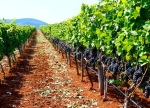
In Mogilovo, Malbec is planted on the organically certified Dabovets vineyard, located on hilly terrain with a 10% slope and an altitude of 360-400 meters. As the highest vineyard in Midalidare, Dabovets benefits from more than 2,800 hours of sunshine per year and more than 100 clear days per year. The temperature amplitudes are large, but the altitude prevents the vines from the spring frosts. The soils are clayey with a specific red color, due to the high content of iron oxides. In soil science, these soils are referred to as red earths and, compared to typical clays, have excellent drainage, further enhanced on Dabovets due to the natural drainage of water along the steep terrain.
No matter the region, Malbec’s approachable style and rich fruit flavors have made it a favorite among red wine lovers.
- Midalidare’s grape varieties: Malbec in a nutshell - Part 1: Essential information about Malbec
- Midalidare’s grape varieties: Malbec – Wines & winemaking - Part 3: Malbec – Styles of wines and winemaking techniques
- Midalidare’s grape varieties: Malbec - Wine & dine - Part 4: How to serve, store and pair Malbec wine with food
Explore our blog
- Blend & Trend: Popular wine blends by Midalidare - Trendy blending styles
- Classic wine blends - Wine Classics from the Old World
- Sauvignon Blanc vs Chardonnay - Two great white varieties side by side
- Aromatic white grapes - Scent explosion in a glass of white wine
- Carbonic Maceration - Fermentation technique in a completely anaerobic atmosphere
- Cane Cut technique - New name for an old tradition
- Vine pruning celebrations around the world - How they celebrate the growing season beginning in different countries
- Sparkling Wine Guide - Sparkling winemaking - Methods for sparkling winemaking
- Sparkling Wine Guide - Traditional sparkling winemaking - The Champagne method
- Sparkling wine guide – Food pairing - Champagne & Sparkling wine food pairing
- Sparkling Wine Guide: Pas Dosé - Sparkling wine with no added sugar
- Sparkling Wine Guide: Blanc de Noirs - A full-bodied, heady Sparkling
- Wine & Glass pairing: Do specific wine glasses make a difference? - Do specific wine glasses make a difference?
- Wine & Glass pairing: Guide to different types of wine glasses with stem - Anatomy - Part 1: Anatomy of a wine glass
- Wine & Glass pairing: Guide to different types of wine glasses with stem - Part 2: Different types of wine glasses
- Wine & Glass pairing: Rose Wine Glasses - Flared Lip Rose Wine Glass
- Wine & Glass pairing: Rose Wine Glasses - Slight Taper Rose Glass
- Wine & Glass pairing: White Wine Glasses - Sauvignon Blanc Wine Glass
- Wine & Glass pairing: White wine glasses - Unoaked Chardonnay Wine Glass
- Wine & Glass pairing: White wine glasses - Оaked Chardonnay Wine Glass
- Wine & Glass pairing: White wine glasses - Riesling Wine Glass
- Wine & Glass pairing: Red wine glasses - Cabernet/Merlot Wine Glass
- Wine & Glass pairing: Sparkling Wine Glasses - Basic types of Champagne and Sparkling wine glasses
- Wine & Glass pairing: Red wine glasses - Old-world style Syrah
- Pinot Noir in Central Otago - What sets Central Otago's Pinot Noir apart from other regions?
- Midalidare’s grape varieties: Mourvedre - Part 1: The variety
- Midalidare’s grape varieties: Mourvedre - Part 2: The terroirs
- Midalidare’s grape varieties: Mourvedre - Part 3: The wines
- Midalidare’s grape varieties: Mourvedre - Part 4: Serving and storage
- Midalidare’s grape varieties: Mourvedre - Part 5: Food pairing
- Midalidare’s grape varieties: Sauvignon Blanc in a nutshell - Part 1: Essential information about Sauvignon Blanc
- Midalidare’s grape varieties: Sauvignon Blanc - The variety and the terroirs - Part 2: Sauvignon Blanc - Specifics of the variety and appropriate regions
- Midalidare’s grape varieties: Chardonnay - The variety and the terroirs - Part 2: Chardonnay - Specifics of the variety and appropriate regions
- Midalidare’s grape varieties: Merlot in a nutshell - Part 1: Essential information about Merlot
- Midalidare’s grape varieties: Merlot - The variety and the terroirs - Part 2: Merlot - Specifics of the variety and appropriate regions
- Midalidare’s grape varieties: Tannat in a nutshell - Part 1: Essential information about Tannat
- Midalidare’s grape varieties: Tannat – The variety and the terroirs - Part 2: Tannat – Specifics of the variety and appropriate regions
- Midalidare’s grape varieties: Tannat – Wines & winemaking - Part 3: Tannat – Styles of wines and winemaking techniques
- Midalidare’s grape varieties: Tannat - Wine & dine - Part 4: How to serve, store and pair Tannat wine with food
- Midalidare’s grape varieties: Syrah in a nutshell - Part 1: Essential information about Syrah