
Marlborough: Wine Region

A combination of a cool yet high sunshine climate, low rainfall and free draining, moderately fertile soil produces uniquely vivid wines.
Marlborough in a nutshell
- Marlborough put New Zealand on the international wine stage with its inimitable Sauvignon Blanc in the 1980s.
- Almost 31,000ha of vines (around 2/3 of the national total) are under the care of local wine producers, making it the country's largest wine region.
- Marlborough wineries offer an incredibly diverse range of varieties, from elegant Pinot Noir to intense Chardonnay, and vivid Aromatics.
- The diverse soils and meso-climates are revealing exciting new sub-regions, and it is within these unique sub-regions that Marlborough’s future lies.
- Marlborough receives an average of 2,409 hours of annual sunshine and just over 25 inches, on average, of rain.
- New Zealand produces only 1% of the world’s wine.
- Around 96% of New Zealand vineyard area operates under independently audited sustainability programs.
- Over 95% of New Zealand wines are sealed with screwcaps.
- Hailed as one of New Zealand’s most sunny and dry regions, Māori referred to the Wairau Valley as ‘Kei puta te Wairau’ – ‘The place with the hole in the cloud’.
History of Marlborough
Missionaries planted the first grapevines on the North Island in the early 1800s, but the first winemaker credited with New Zealand production was James Busby in 1836. It wasn’t until well over a century later, in the early 1970s, that viticulture took hold in the Marlborough region. Advances in planting and the establishment of an official trade organization, the Wine Institute of New Zealand (now called NZ Winegrowers), spawned an uptick in new vineyards and wineries. Marlborough Sauvignon Blanc came onto the scene in the 1980s, propelling the region onto the international wine map. Today, New Zealand is considered a young and dynamic wine industry focused on quality and innovation.
August 2023 marks 50 years of the Marlborough Wine Region.
In 1873 David Herd planted a small vineyard of Brown Muscat at Aunstfield in Fairhall. One hundred years later, in August 1973, Montana started planting vineyards in Marlborough. At the celebration ceremony, Frank Yukich, the man behind the plan to buy land and plant grapes here made the statement that “Wines from here will become world famous.” At the time, no one took him seriously, but the prophetic words would go on to be remembered as this variety took Marlborough’s name to the world.
But while Montana Wines was the first to place its faith in the region, there have been many others that have helped secure its reputation, kick-starting what would become the province’s dominant industry, responsible for around 80% of New Zealand’s wine exports, and creating a global reputation for Sauvignon Blanc.
1873 - Marlborough’s first vineyard was planted by Scotsman David Herd in the southern valleys.
1880 - Marlborough’s first winery was established by George Freeth, near Picton. The winery was closed in 1958.
1973 - Commercial planting began at Montana’s Brancott Estate at Fairhall.
1980 - Marlborough Grapegrowers Association Incorporated established.
1984 - Phylloxera outbreak first recorded and widespread by 1992.
1985 - First Marlborough Wine & Food Festival
1986 - Marlborough Sauvignon Blanc (Hunters) awarded the top three trophies at the London International Wine Show.
1986 - Oversupply of unsuitable varieties leading to Government sponsored vine pull.
1992 - Wine Marlborough Limited formed as the trading company for Marlborough Winegrowers Association.
1997 - 2,655 ha of grape vines in Marlborough.
1999 - 60 Winery members of Wine Marlborough and 3,500 ha of vines.
2007 - 110 Winery members of Wine Marlborough and 21,276 ha of vines.
2008 - 25th anniversary of the Marlborough Wine Festival.
2009 - Marlborough celebrates 30th anniversary of the region’s first Sauvignon Blanc vintage.
2012 - Marlborough produces 72% of New Zealand’s 2012 vintage.
2013 - 40th Anniversary of Marlborough’s first commercial plantings.
2016 - The first International Sauvignon Blanc Celebration is held in Marlborough.
2016 - Winepress Magazine celebrates its 25th anniversary.
2020 - Marlborough Winegrowers Association celebrates 40 years.
Climate
Situated at the top of New Zealand’s South Island, with Cook Strait to the north and the Pacific Ocean to the east, Marlborough experiences a maritime climate. This provides a cooling influence which, coupled with some of the highest sunshine hours in the country, creates the perfect environment for grape growing.
Hot days and cooler nights add to the complexity of fruit grown in Marlborough, and the diurnal range of around 11 degrees during summer keeps acid levels high over long ripening times creating piercing fruit intensity and strong varietal expression. The eastern coastal aspect bestows cooling sea breezes and protective mountains give relief from extreme rain and wind. Long Indian summers occasionally dice with drought but more often allow a wide range of styles to flourish.
Marlborough subregions
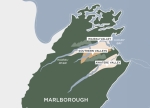
Southern Valleys
Wrapping around the surrounding hills, the Omaka, Fairhall, Brancott, Ben Morvan and Waihopai Valleys make up this important sub-region. Soil and meso-climates vary but tend to be heavier and contain more clay than Wairau. It also becomes cooler and drier further south into the valleys. A broad range of varieties are grown according to the merit of each site, with particularly good Pinot Noir and aromatics being produced by the area.
The central part of Marlborough is locked in between two large rivers - the Wairau and the Awatere. There, in the very heart of the Southern Valleys, lies the Waihopai Valley and Craiglochart Vineyard – the home of Midalidare New Zealand Marlborough Sauvignon Blanc.
Wairau Valley
The Wairau sits closer to the Richmond Ranges, which sees more rainfall than the Wither Hill range that dominates the Southern Valley. It is these ranges that protect the Wairau Valley and Marlborough from weather events coming from the north and northwest. Old, gravely riverbed soils, and diverse aspects and rainfall create numerous meso-climates within this sub-region. Broadly, it covers a range of cooler, drier inland sites; barren stony, early ripening sites; and sea-breeze moderated coastal sites. Across the sub-region wines reflect the strengths of individual vineyards and vignerons, but all have the hallmark fruit intensity and body.
"Wairau" is a Māori word meaning "many waters". This subregion is broadly defined by its proximity to the 170km long Wairau River that runs from the mountains in the west to the ocean at Cloudy Bay. Marlborough's earliest vineyards were established on the characteristically alluvial river plains that include the acclaimed Rapaura and Renwick areas.
Awatere Valley
The Awatere Valley is the most geographically distinct sub-region, lying south of the Wairau Valley and stretching inland from the sea, and climbing towards the inland Kaikoura ranges. Cooler, drier, windier and often with a degree of elevation, sites with typically lower yields produce bright, aromatic Pinot Noir and dramatic, distinctive Sauvignons, both of which are attracting increasing international acclaim.
Southeast of Wairau and closer to the coast, the vineyards of the narrow Awatere Valley include the Awatere River valley, Seaview, Redwood Pass and Blind River. The area can be more exposed to cold weather from the South than the other sub-regions, which tends to create a later ripening crop and even longer growing season. The soils are typically alluvial gravel and wind-borne loess, often exhibiting a diverse composition of stone materials. The Māori word Awatere means fast flowing stream.
The Awatere subregion was the last to be fully recognized even though its high quality and potential was noted by early pioneers who planted in the late 1980's. Prior to becoming highly regarded viticultural land this area also formed part of giant stations such as Flaxboume and Starborough and is also where Marlborough's tallest peak, Mount Tapuae-o-Uenuku (2,880m or 9,450 feet) is found.
- Marlborough: Southern Valleys - The home of Midalidare New Zealand Sauvignon Blanc
- Marlborough: Grapes and Wines - Specifics of the varieties and characteristics of the wines
- Marlborough: Sauvignon Blanc - What sets Marlborough's Sauvignon Blanc apart from other regions?
- Central Otago: Wine region - History, climate, soils and sub-regions of Central Otago
- Central Otago: Cromwell - The home of Midalidare New Zealand Central Otago Stag’s Run Pinot Noir
- Central Otago: Grapes and Wines - Specifics of the varieties and wines characteristics
- Pinot Noir in Central Otago - What sets Central Otago's Pinot Noir apart from other regions?
Explore our blog
- Blend & Trend: Popular wine blends by Midalidare - Trendy blending styles
- Classic wine blends - Wine Classics from the Old World
- Sauvignon Blanc vs Chardonnay - Two great white varieties side by side
- Aromatic white grapes - Scent explosion in a glass of white wine
- Carbonic Maceration - Fermentation technique in a completely anaerobic atmosphere
- Cane Cut technique - New name for an old tradition
- Vine pruning celebrations around the world - How they celebrate the growing season beginning in different countries
- Sparkling Wine Guide - Sparkling winemaking - Methods for sparkling winemaking
- Sparkling Wine Guide - Traditional sparkling winemaking - The Champagne method
- Sparkling wine guide – Food pairing - Champagne & Sparkling wine food pairing
- Sparkling Wine Guide: Pas Dosé - Sparkling wine with no added sugar
- Sparkling Wine Guide: Blanc de Noirs - A full-bodied, heady Sparkling
- Wine & Glass pairing: Do specific wine glasses make a difference? - Do specific wine glasses make a difference?
- Wine & Glass pairing: Guide to different types of wine glasses with stem - Anatomy - Part 1: Anatomy of a wine glass
- Wine & Glass pairing: Guide to different types of wine glasses with stem - Part 2: Different types of wine glasses
- Wine & Glass pairing: Rose Wine Glasses - Flared Lip Rose Wine Glass
- Wine & Glass pairing: Rose Wine Glasses - Slight Taper Rose Glass
- Wine & Glass pairing: White Wine Glasses - Sauvignon Blanc Wine Glass
- Wine & Glass pairing: White wine glasses - Unoaked Chardonnay Wine Glass
- Wine & Glass pairing: White wine glasses - Оaked Chardonnay Wine Glass
- Wine & Glass pairing: White wine glasses - Riesling Wine Glass
- Wine & Glass pairing: Red wine glasses - Cabernet/Merlot Wine Glass
- Wine & Glass pairing: Sparkling Wine Glasses - Basic types of Champagne and Sparkling wine glasses
- Wine & Glass pairing: Red wine glasses - Old-world style Syrah
- Midalidare’s grape varieties: Mourvedre - Part 1: The variety
- Midalidare’s grape varieties: Mourvedre - Part 2: The terroirs
- Midalidare’s grape varieties: Mourvedre - Part 3: The wines
- Midalidare’s grape varieties: Mourvedre - Part 4: Serving and storage
- Midalidare’s grape varieties: Mourvedre - Part 5: Food pairing
- Midalidare’s grape varieties: Sauvignon Blanc in a nutshell - Part 1: Essential information about Sauvignon Blanc
- Midalidare’s grape varieties: Sauvignon Blanc - The variety and the terroirs - Part 2: Sauvignon Blanc - Specifics of the variety and appropriate regions
- Midalidare’s grape varieties: Chardonnay - Chardonnay in a nutshell - Part 1: Essential information about Chardonnay
- Midalidare’s grape varieties: Chardonnay - The variety and the terroirs - Part 2: Chardonnay - Specifics of the variety and appropriate regions
- Midalidare’s grape varieties: Merlot in a nutshell - Part 1: Essential information about Merlot
- Midalidare’s grape varieties: Merlot - The variety and the terroirs - Part 2: Merlot - Specifics of the variety and appropriate regions
- Midalidare’s grape varieties: Tannat in a nutshell - Part 1: Essential information about Tannat
- Midalidare’s grape varieties: Tannat – The variety and the terroirs - Part 2: Tannat – Specifics of the variety and appropriate regions
- Midalidare’s grape varieties: Tannat – Wines & winemaking - Part 3: Tannat – Styles of wines and winemaking techniques
- Midalidare’s grape varieties: Tannat - Wine & dine - Part 4: How to serve, store and pair Tannat wine with food
- Midalidare’s grape varieties: Syrah in a nutshell - Part 1: Essential information about Syrah
- Midalidare’s grape varieties: Malbec in a nutshell - Part 1: Essential information about Malbec
- Midalidare’s grape varieties: Malbec – The variety and the terroirs - Part 2: Malbec – Specifics of the variety and appropriate regions
- Midalidare’s grape varieties: Malbec – Wines & winemaking - Part 3: Malbec – Styles of wines and winemaking techniques
- Midalidare’s grape varieties: Malbec - Wine & dine - Part 4: How to serve, store and pair Malbec wine with food