
Midalidare’s grape varieties: Meunier - The variety and the terroirs

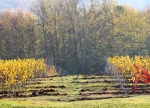
Meunier is a black wine grape variety most noted for being one of the three main grapes used in the making of Champagne (the other two; the black Pinot Noir and the white Chardonnay). Until recently, Champagne makers did not acknowledge Meunier, preferring to emphasize the use of the other noble varieties, but now Meunier is gaining recognition for the body and richness it contributes to sparkling wines.
Meunier essentials
Meunier's overriding advantage is its resistance to frost, chlorosis and coulure (the failure of the flowers to develop into berries). It buds and flowers late and ripens early, also an advantage in cold growing areas. Well-suited to chalky clay or loam soils, it is susceptible to rot due to the compactness of its bunches. The berries are deep blue and oval and the fruit is high in acidity, moderately high in alcohol, low in tannin and full of sweet fruit flavour.
In the European Union, Meunier is officially called by other names: Mlynarka (Czech Republic), Müllerrebe (Germany), Pinot Meunier (Belgium, Czech Republic, Spain) and Schwarzriesling (Austria). These synonyms are officially recognized in France regarding plant propagation material.
In France, Meunier is officially listed in the "Catalogue of vine varieties" on the A list and classified. This variety is also listed in the catalogues of other Member States of the European Union: Austria, Belgium, Bulgaria, Czech Republic, Germany, Italy, Netherlands and Spain.
Terroirs
Compared to the other Champagne grapes Chardonnay and Pinot noir, Meunier buds later in the growing season but ripens earlier. This unique characteristic makes variety less susceptible to winter and spring frosts. It grows prolifically in the clay-packed soil of Vallée de la Marne, the subregion of Champagne that follows the Marne River west of Épernay toward Paris. While Meunier makes up about 32% of the total vineyard plantings in Champagne, 62% can be found in Vallée de la Marne.
Meunier’s ability to thrive in the most challenging soils and climates cemented its reputation as a robust and reliable workhorse, while the more delicate chardonnay and pinot noir required the perfect growing conditions that only the very best Premier and Grand Cru plots provide.
Meunier in France
Unsurprisingly, Meunier is most commonly grown in the Champagne region of France. It is more prevalent in the cooler, north-facing vineyards in the northern area of the region. The grape thrives here due to its ability to ripen in much cooler climates. Outside of this area it can be found in the Loire Valley and Moselle regions of France.
The Vallée de la Marne (Champagne, France): This is the historic and spiritual home of Meunier, where it accounts for a major portion of vineyard plantings. The combination of clay, marl, and sand imparts a rich, fruity, and highly aromatic profile to the wines.
Aube (Champagne, France): In this more southern, cooler pocket of Champagne, Chardonnay and Pinot Noir sometimes struggle to ripen. Meunier has become a signature grape here, developing remarkable richness and body.
Meunier around the world: Europe
While Meunier is heavily planted in France, its adaptability to cool climates has allowed it to succeed in specific microclimates globally. Around the world Meunier is grown in cooler European regions such as Germany (where it is used to produce still wines) and England. When it comes to New World, Australia and California produce very small amounts, as well as Bulgaria.
Baden-Württemberg (Germany): Meunier perhaps receives the most attention outside of France in Württemberg, Germany. There it goes to making Schillerwein, a light and fresh rosé style, though some makers also produce dry red table wines. Here the variety is known as both Müllerrebe (‘müller’ means miller so it’s also a reference to the dustiness on its leaves) or Schawrzriesling. The latter is misleading because it means ‘black Riesling,’ but it is not related to Riesling at all.
Within Europe, Meunier can also be found in Austria and Switzerland, neither of which are surprising since their cool climates tend to mean they cultivate grapes similar to those of German and cooler parts of France.
Thracian Lowlands (Bulgaria): The Meunier plantations in Mogilovo are located on the Dabovets vineyard, which is also certified for organic viticulture. Although with a slightly warmer climate, the region is characterized by extremely large temperature amplitudes and mild winters, which favors the adaptation and development of the variety. In Midalidare, Meunier is used only to produce sparkling wine under the traditional method.
Meunier around the world
Among New World wine producing regions, Australia, New Zealand, Canada, and California have all seen experimentation with Meunier. With trends learning towards lower alcohol wines, Meunier is gathering a little cult following that predicts more experimentation in the future.
Oregon (USA): The cool, moist climate of the Willamette Valley provides an ideal proxy for Meunier's preferred conditions, producing elegant sparkling and still expressions.
Victoria (Australia): Australia has a rich history with Meunier and a modest though material footprint in production. Most sites reside in Tasmania, the Adelaide Hills, the Yarra Valley and the King Valley, and were initially planted for sparkling wine to replicate the Champagne model. But it’s Victoria’s Great Western region that holds the crux of the plotline.
- Midalidare’s grape varieties: Meunier in a nutshell - Part 1: Essential information about Meunier
- Midalidare’s grape varieties: Meunier – Wines & winemaking - Part 3: Meunier – Styles of wines and winemaking techniques
- Midalidare’s grape varieties: Meunier - Wine & dine - Part 4: How to serve, store and pair Meunier wine with food
Explore our blog
- Blend & Trend: Popular wine blends by Midalidare - Trendy blending styles
- Classic wine blends - Wine Classics from the Old World
- Sauvignon Blanc vs Chardonnay - Two great white varieties side by side
- Aromatic white grapes - Scent explosion in a glass of white wine
- Carbonic Maceration - Fermentation technique in a completely anaerobic atmosphere
- Cane Cut technique - New name for an old tradition
- Vine pruning celebrations around the world - How they celebrate the growing season beginning in different countries
- Malbec vs Tannat - Two great red close relative varieties side by side
- Colours in wine labeling - What do Midalidare monochrome labels tell us about the wines?
- Sauvignon Blanc vs Pinot Gris - Crisp White Wine Excellence
- Versatile Sauvignon Blanc - Sauvignon Blanc: Versatility from Vineyard to Bottle
- Sparkling Wine Guide: Sparkling winemaking - Methods for sparkling winemaking
- Sparkling Wine Guide: Traditional sparkling winemaking - The Champagne method
- Sparkling Wine Guide: Food pairing - Champagne & Sparkling wine food pairing
- Sparkling Wine Guide: Pas Dosé - Sparkling wine with no added sugar
- Sparkling Wine Guide: Blanc de Noirs - A full-bodied, heady Sparkling
- Sparkling Wine Guide: Blanc de Blancs - Sparkling wine all finesse and lightness
- Sparkling Wine Guide: Non-vintage Brut Style - A sparkling wine for all occasions
- Sparkling Wine Guide: Sparkling Rosé Style - A style of elegance and diversity
- Sparkling Wine Guide: Sparkling wines by ageing - Vintage vs Non-vintage
- Sparkling Wine Guide: Sparkling wines by sweetness scale - How much sugar in sparkling wine
- Sparkling Wine Guide: Sparkling wines by region - Sparkling wine journey around the world
- Sparkling Wine Guide: Oak ageing of sparkling wines - Oak usage in traditional sparkling winemaking
- Marlborough: Wine Region - History, climate, viticulture and sub-regions of Marlborough
- Marlborough: Southern Valleys - The home of Midalidare New Zealand Sauvignon Blanc
- Marlborough: Grapes and Wines - Specifics of the varieties and characteristics of the wines
- Marlborough: Sauvignon Blanc - What sets Marlborough's Sauvignon Blanc apart from other regions?
- Central Otago: Wine region - History, climate, soils and sub-regions of Central Otago
- Central Otago: Cromwell - The home of Midalidare New Zealand Central Otago Stag’s Run Pinot Noir
- Central Otago: Grapes and Wines - Specifics of the varieties and wines characteristics
- Pinot Noir in Central Otago - What sets Central Otago's Pinot Noir apart from other regions?
- Midalidare’s grape varieties: Pinot Noir in a nutshell - Part 1: Essential information about Pinot Noir
- Midalidare’s grape varieties: Malbec in a nutshell - Part 1: Essential information about Malbec
- Midalidare’s grape varieties: Syrah in a nutshell - Part 1: Essential information about Syrah
- Midalidare’s grape varieties: Tannat in a nutshell - Part 1: Essential information about Tannat
- Midalidare’s grape varieties: Merlot in a nutshell - Part 1: Essential information about Merlot
- Midalidare’s grape varieties: Mourvedre - Part 1: The variety
- Midalidare’s grape varieties: Sauvignon Blanc in a nutshell - Part 1: Essential information about Sauvignon Blanc
- Midalidare’s grape varieties: Chardonnay in a nutshell - Part 1: Essential information about Chardonnay
- Wine & Glass pairing: Do specific wine glasses make a difference? - Do specific wine glasses make a difference?
- Wine & Glass pairing: Guide to different types of wine glasses with stem - Anatomy - Part 1: Anatomy of a wine glass
- Wine & Glass pairing: Guide to different types of wine glasses with stem - Part 2: Different types of wine glasses
- Wine & Glass pairing: Rose Wine Glasses - Flared Lip Rose Wine Glass
- Wine & Glass pairing: Rose Wine Glasses - Slight Taper Rose Glass
- Wine & Glass pairing: White Wine Glasses - Sauvignon Blanc Wine Glass
- Wine & Glass pairing: White wine glasses - Unoaked Chardonnay Wine Glass
- Wine & Glass pairing: White wine glasses - Оaked Chardonnay Wine Glass
- Wine & Glass pairing: White wine glasses - Riesling Wine Glass
- Wine & Glass pairing: Red wine glasses - Cabernet/Merlot Wine Glass
- Wine & Glass pairing: Sparkling Wine Glasses - Basic types of Champagne and Sparkling wine glasses
- Wine & Glass pairing: Red wine glasses - Old-world style Syrah